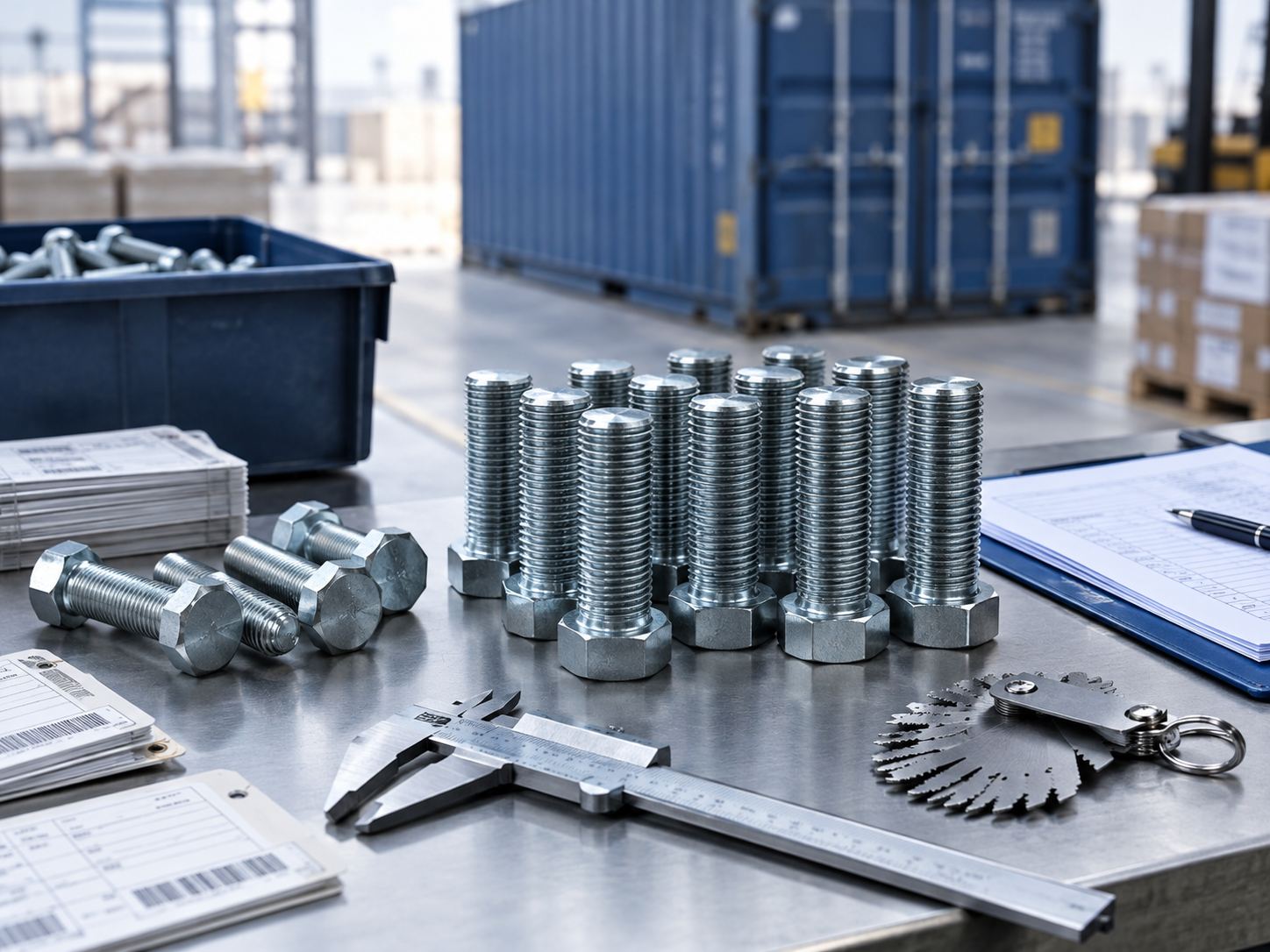
US Standard Bolt Export Compliance Guide: From Standard Confirmation to Packing Release

Daniel
With experience in fastener manufacturing and export sales, we specialize in bolts, nuts, screws, self-drilling screws, fully threaded rods, and customized fastening solutions for construction, machinery, automotive, and industrial applications.
Starting with a return notice: bolts shipped on time, so why were they still rejected?
For an order of hex bolts destined for the US market, the factory completed production on schedule, the freight forwarder loaded the container on time, and the container left the port without issue. However, after the goods arrived at the destination port, the buyer found problems during inspection: the physical parameters deviated from the procurement requirements, and the accompanying inspection documents and label information did not match. As a result, the container was detained, and some goods were required to be returned or reworked.
For exporting companies, the cost of such situations is not just the payment for a few tons of bolts. Round-trip freight, port storage fees, rework or remake costs, and the risk of claims due to delivery delays often add up and far exceed the profit of the order itself. What is even more frustrating is that the problem usually does not lie in whether production took place, but in whether production, inspection, and certification were carried out according to the same set of requirements. The buyer understands according to one standard, while the factory executes according to another habit; the deviation in between is not discovered before loading and is ultimately exposed only at the destination port.

This article uses this export order of US-standard bolts as a thread to break down compliance checkpoints one by one, including standards, grades, dimensions, materials, surface treatment, inspection documents, and packaging markings, to help exporting companies stop problems before loading.
The first checkpoint: first confirm what "US standard" actually refers to
"US-standard bolts" is not a single specification. It may refer to different applicable standards, different product types, different performance grades and dimensional series, and even different versions of the same standard differ. If an order only says "US standard," it effectively means the technical requirements have not been confirmed.

Take high-strength fasteners for structural use as an example. The relevant standard systems clearly specify the types, materials, mechanical properties, and test methods for bolts, and common grades such as A325 belong to this system. Exporting companies cannot judge the applicable requirements solely based on old names, industry colloquialisms, or verbal abbreviations, and certainly cannot deliver ordinary screws or nuts directly as structural fasteners.
In actual operation, drawings, purchase orders, and technical agreements should be checked together: whether the product is a hex bolt or a heavy hex head type, whether the grade and type of the matching nut are compatible, whether the dimensional series is inch or metric, and which version of the standard is cited as the acceptance basis. Take heavy hex structural bolts as an example. These products are usually used for connection nodes in steel structures, bridges, and industrial buildings, and have clear requirements for material strength, head dimensions, and matching parts. They look similar to ordinary hex bolts but have completely different performance positioning and cannot be used interchangeably.
It is recommended that both buyer and seller confirm the standard version and acceptance basis before quotation and sampling, and clearly state "according to which standard, which items are inspected, and which document is used for judgment." This is the foundation for all subsequent steps.
The second checkpoint: performance grades and matching parts cannot "look about the same"
High-strength bolts look very similar, but the key is whether the material, heat treatment process, and mechanical properties meet the grade specified in the order. Even with the same hex head type, ordinary carbon steel bolts and high-strength structural bolts may differ by a grade in indicators such as tensile strength, hardness, and elongation. This cannot be judged by the naked eye, nor can inspection be replaced by "this is how we have always done it."
Matching parts are also easily overlooked. The grade, thread specification, and assembly requirements of bolts and nuts need to be confirmed as a set. A single part may pass inspection but still fail to meet requirements when assembled. For example, if high-strength bolts are paired with low-grade nuts, thread stripping or insufficient preload may occur during assembly; conversely, if the nut grade is too high and the bolt does not match, assembly abnormalities may also result. Therefore, the order should clearly specify the matching relationship between bolts and nuts, rather than ordering and accepting them separately.
For other products such as studs and flange bolts, each item should be confirmed according to its own drawings and standards, and the inspection conclusions for one type of product cannot be applied to all fasteners. When necessary, inspect mechanical properties, hardness, chemical composition, or other applicable items according to the agreement, and specify the sampling plan and judgment rules in the technical agreement to avoid disputes after shipment due to "inconsistent inspection methods."
The third checkpoint: dimensions, threads, and surface treatment are high-frequency return points
Dimensional issues account for a high proportion of return reasons, and the most common is mixing US dimensions with metric dimensions. If any one of the nominal diameter, length, head across-flats width, thread series, and tolerance does not match, on-site assembly may be impossible. For on-site steel structure construction, if bolts cannot fit into holes or nuts cannot be tightened fully, the entire batch may be judged unusable.
Thread form, hand, and gauge acceptance requirements also need to be confirmed in advance, and the fit between bolts and nuts must be ensured to be consistent. If the buyer specifies a thread gauge acceptance method, the factory should actually implement it in outgoing inspection rather than only performing visual checks.
Surface treatment must match the order agreement. Coating treatments and hot-dip galvanizing differ significantly in coating thickness, appearance, and their effect on external thread fit. When the hot-dip galvanized layer is thick, matching clearance may need to be reserved or subsequent treatment performed. For products such as stainless steel fasteners and carbon steel nuts, material and surface requirements should be checked separately, and general descriptions such as "anti-rust treatment" cannot replace specific technical conditions. For orders with salt spray test or coating thickness requirements, the inspection method and judgment standard should also be confirmed.
The fourth checkpoint: documents, traceability, and markings must match the actual goods
During destination port inspection, buyers usually look at documents first and then the goods. Material certificates, inspection reports, batch records, and necessary third-party documents should be within the scope specified by the buyer's agreement and applicable standards. The problem with documents often is not whether they exist, but whether they match.
The following need to be checked item by item: whether the grade, class, specification, batch, and quantity in the report are consistent with the packing list and physical labels; whether the product head markings, packaging labels, and shipping marks comply with the agreement; whether the batch is traceable; and whether different batches are mixed but share a single report.
One point should be emphasized here: more documents are not necessarily better. The key is that the content is authentic, applicable, and mutually consistent. Using a generic template as compliance proof for that batch will only magnify the problem once the buyer investigates production records or requests third-party verification. For fastener export suppliers, document management capability is itself part of process control capability.
The fifth checkpoint: the final check before loading; do not let packaging and mixed loading undermine compliance
Many compliance problems do not arise in production but in warehouse picking and loading. If bolts and nuts of different specifications, grades, and surface treatments are mixed in the same carton or on the same pallet, or if labels are applied incorrectly, quantities are short, or batches are confused, all prior inspection work will be meaningless.
It is recommended to pack by specification, grade, surface treatment, and batch in separate areas, check inner and outer packaging labels, quantities, net weight and gross weight one by one against the packing list, and also check whether moisture-proof, rust-proof, and transport protection meet order requirements. For sea freight orders, the choice of anti-rust oil and packaging sealing especially need to be confirmed.
A more effective approach is to establish a pre-shipment checklist: confirm and archive the order technical conditions, inspection results, markings, documents, packaging, and loading photos item by item. For urgent orders or mixed-container orders with multiple varieties, arrange independent review to reduce the probability of warehouse picking and labeling errors. These actions may seem trivial, but they are exactly what determine whether the container can be released smoothly after arrival.
An executable compliance process for US-standard bolt exports
Linking the above checkpoints together can form a closed-loop process from order acceptance to after-sales:
- Order acceptance stage:Write the standards, grades, dimensions, materials, surface treatment, acceptance methods, and document requirements into the technical agreement, and keep the drawing version consistent with the order version.
- Production stage:Record raw materials, processing, heat treatment, and inspection information by batch; obtain written customer confirmation promptly when deviations are found, and do not substitute materials or change processes without authorization.
- Shipping stage:Release only after completing dimensional and performance inspections, cross-checking documents, rechecking labels, and inspecting packing; retain photos and records at key points.
- After-sales stage:Retain order versions, sample confirmations, inspection records, and shipping documents to facilitate handling buyer objections and batch traceability.
This process is not complicated; what is difficult is executing every step properly and maintaining consistency across different product lines. For a factory that also produces hex bolts, flange bolts, studs, and nuts, it is recommended to maintain separate checklists by product category to avoid applying one template to all orders.
Choosing a Fastener Partner: Process Control Matters More Than Low Price
When evaluating fastener manufacturers or fastener suppliers, price is only one dimension. More worthy of attention are the accuracy of their standard identification, the completeness of batch traceability, the authenticity of their inspection capabilities, and the actual process for export document management. These capabilities cannot be seen on a quotation sheet, yet they directly determine whether an order can be delivered smoothly.
Different product categories can be verified separately. For example, when evaluating hex bolt manufacturers, focus on their incoming material records, heat treatment control, and mechanical property testing; when evaluating flange bolt suppliers, pay attention to flange face dimensions and mating requirements; when evaluating heavy hex nut manufacturers, confirm their grade matching and thread gauge acceptance capabilities. Verifying equipment, testing, and quality records is more meaningful than just looking at promotional catalogs.
Whether purchasing stainless steel fasteners, lock nuts, custom socket head screws, custom special-shaped fasteners, or non-standard fastener machining, the drawing version and acceptance criteria should be confirmed first, and only then should price and delivery time be discussed. For custom bolt wholesale orders, the sample confirmation step must not be omitted; the content of the sample confirmation should be documented in writing and used as the basis for batch acceptance.
Buyers should also be reminded: keywords such as expansion bolt wholesale, self-tapping screw manufacturers, self-drilling screw suppliers, and machine screw wholesale represent different product requirements and application scenarios, and must not be confused with the compliance requirements for high-strength structural bolts. Likewise, the capabilities of carriage bolt factories and stainless steel fastener manufacturers differ in focus. When choosing a partner with fastener OEM or fastener export supply experience, require them to clearly define change management, sample confirmation, and shipping inspection responsibilities, and write the boundaries of responsibility into the contract.
Conclusion: Getting Containers Through Customs Smoothly Depends on Consistency from Order to Documents
Returning to the container that was rejected at the beginning, the problem is rarely caused by a single reason. Deviations in standard interpretation, mismatches in physical parameters, incompatible mating parts, or inconsistencies in documents or markings—any problem at any step can cause an order to get stuck on compliance. Moreover, these steps are interrelated: if the standard is not clearly confirmed, inspection loses its basis; if inspection records are incomplete, documents cannot prove themselves; if documents do not match the physical goods, even standardized packaging will not help.
For export enterprises, a feasible action recommendation is: first write the technical requirements clearly, then link production, inspection, traceability, and packaging into a closed loop, and finally close the loop with a pre-shipment checklist. Exporting ASTM bolts is not simply delivering products, but delivering a verifiable consistency. Work with reliable fastener suppliers to cross-check requirements and complete compliance work before packing, so as to reduce the risk of rework and rejection and enable every container to pass customs smoothly.