How to Calculate Total Cost of Ownership in Fastener Procurement: From Unit Price Comparison to Full Lifecycle Management

Daniel
With experience in fastener manufacturing and export sales, we specialize in bolts, nuts, screws, self-drilling screws, fully threaded rods, and customized fastening solutions for construction, machinery, automotive, and industrial applications.
Don't Focus Only on Unit Price When Sourcing Fasteners: B2B Industry Insights That Help Purchasing Managers Calculate Total Cost of Ownership
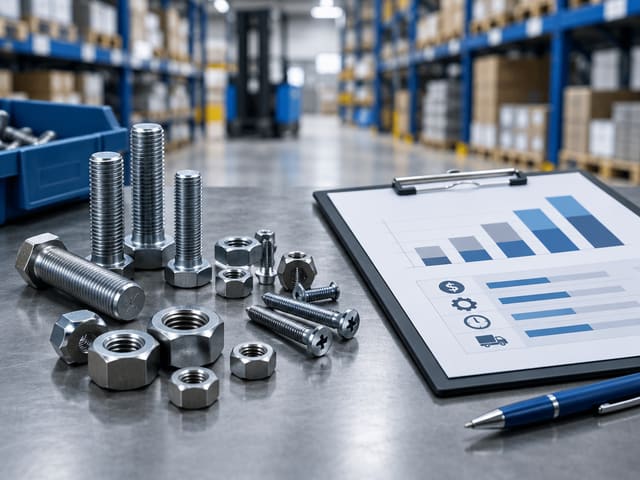
In fastener procurement, the numbers on a quotation are often the most intuitive and the easiest to base decisions on. But for purchasing managers who deal with lead times, incoming inspection, and production line stability every day, what truly determines cost is never that single line item unit price—it is all the spending that a screw, nut, or bolt triggers from inquiry to assembly and through to end of life.
Why can a lower quote actually mean a higher total procurement cost?
A common dilemma for purchasing managers: the unit price metrics look good and the quarterly report can be justified, but delivery delays, batch inconsistency, assembly rework, and even field failures all ultimately drive up actual spending in another form. A single full-batch sorting caused by a specification deviation, or a single line stoppage caused by lead time fluctuation, often costs far more than the unit price difference.
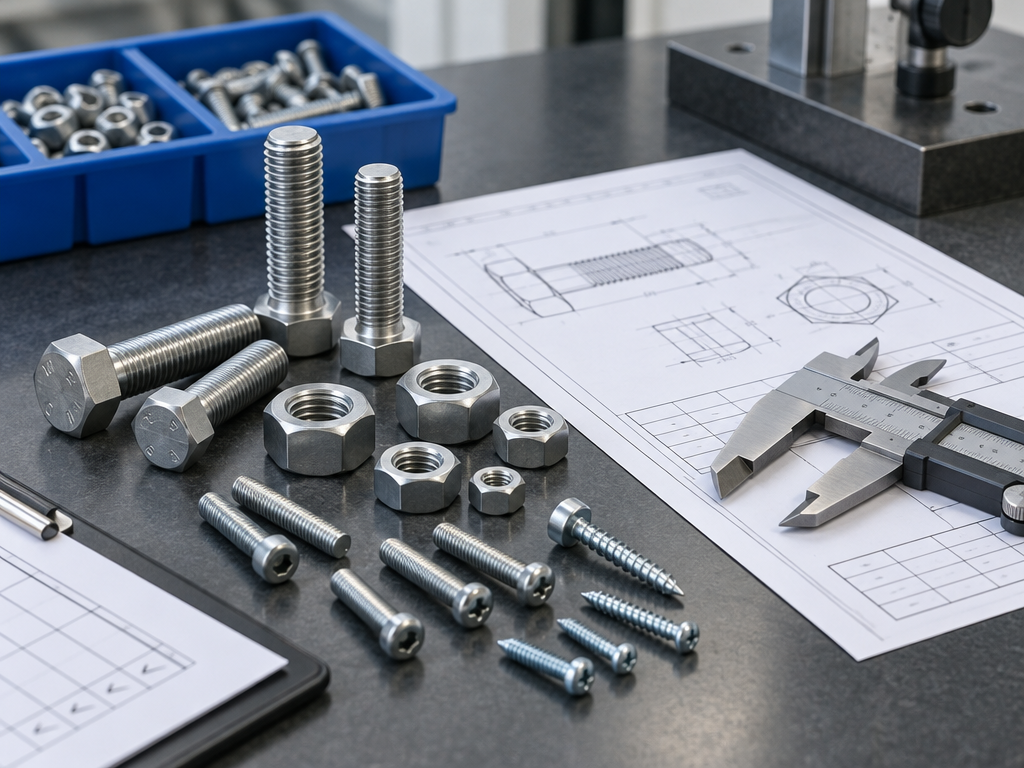
Therefore, the key to procurement decisions is not just the quote for a screw, nut, or bolt, but the costs the product generates across procurement, incoming inspection, inventory, assembly, and use. If a low-price option leads to higher inspection frequency, longer assembly hours, or more frequent maintenance and replacement, its overall cost may actually be higher.
This article provides a practical total cost of ownership (TCO) calculation framework for fasteners to help procurement teams make hidden costs visible. It does not cite industry data from unidentified sources or unverified ROI cases; all calculation bases are grounded in data that the company itself can collect.

What items specifically make up the total cost of ownership in fastener procurement?
The core idea of TCO is to aggregate costs scattered across different departments onto the same product unit. For fasteners, this can usually be broken down into the following four categories.
- Procurement cost:Quotes, tooling or customization fees, packaging costs, payment terms, and exchange rate effects. Cross-border procurement also needs to consider the capital tie-up caused by the settlement method.
- Quality cost:Incoming inspection, sampling and re-inspection, returns and exchanges, sorting, rework, and disposal of nonconforming products. Suppliers with poor batch consistency often continuously consume resources in this item.
- Supply and inventory cost:Transportation, tariffs, lead time fluctuation, safety stock, warehousing occupation, and line stoppage risk caused by stockouts. The more unstable the lead time, the higher the safety stock level.
- Usage cost:Installation labor hours, tool and process compatibility, connection failure risk, maintenance and replacement frequency, and product lifecycle impact. A single rework at the assembly end can offset the price advantage of an entire batch purchase.
It is recommended to establish a simple basis:Unit TCO = total procurement-related costs ÷ quantity of qualified and actually usable products. The value of this formula is that it counts nonconforming products, rework, and scrap into the denominator, naturally exposing options that are "cheap but don't work well." Companies should fill in cost items based on their own data rather than applying external averages.
Start with specifications: avoid putting different products on the same price comparison table
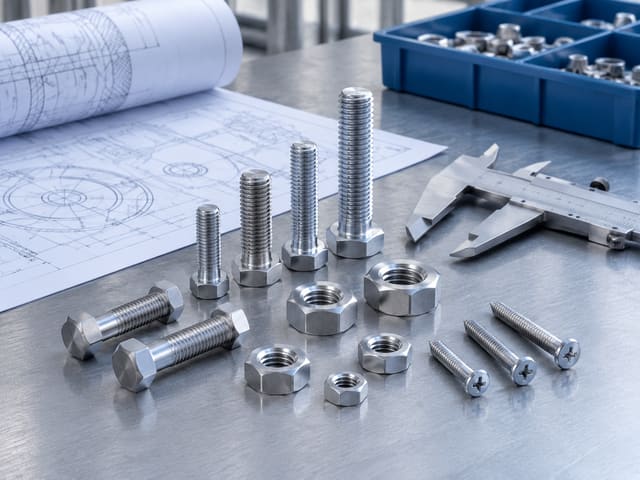
Much distorted price comparison stems not from price but from inconsistent specification bases. Before comparing quotes from different suppliers, first align materials, strength grades, dimensional tolerances, surface treatment, applicable standards, packaging, and inspection requirements.
For hex bolts, flange bolts, studs, and matching nuts, verify the application conditions, connection methods, and matching requirements, and avoid comparing prices solely by name or appearance. For the same "hex bolt," differences in strength grade, thread accuracy, and surface treatment are enough to make two quotes non-comparable.
When purchasing stainless steel fasteners, focus on confirming material identification, corrosion resistance requirements, and applicable environments; do not treat "stainless steel" as a single performance grade. Different grades perform noticeably differently under salt spray, humidity, and temperature conditions, and a single confirmation at the selection stage can often save a large amount of replacement cost later.
For custom socket head screws, custom special-shaped fasteners, and non-standard fastener machining, clarify the drawing version, acceptance standards, sample confirmation, and change process in advance. Most disputes over custom parts arise not from price but from "which drawing version prevails" and "whether the sample represents mass production."
Take machine screws as an example: products with a higher degree of standardization actually require clearer specifications. DIN 963 slotted countersunk head machine screws use a countersunk head, slotted drive, and metric thread, and are commonly found in equipment panels, furniture hardware, and general assembly scenarios, with carbon steel, stainless steel, and brass material options; DIN 965 cross recessed countersunk head machine screws are more common in electrical equipment, furniture, and panel assembly, and the cross recess drive is more conducive to tool compatibility during batch assembly. Only when the head type, drive type, material, and thread specifications of such products are written into the inquiry document does price comparison become meaningful.
Evaluate suppliers with quantifiable metrics, not just the quotation
Supplier evaluation should be built on collectible and verifiable metrics, not impressions or a single collaboration experience.
- Quality metrics:Batch qualification rate, completeness of dimensional and material documents, and closure of issue response and corrective actions.
- Delivery metrics:On-time delivery rate, actual lead time fluctuations, emergency order handling capability, and production capacity transparency.
- Service and risk indicators:Technical communication efficiency, traceability, backup capacity, packaging adaptability, and cross-border delivery support.
It is recommended to include fastener manufacturers and fastener suppliers in a unified scoring table, with weights set according to criticality, procurement amount, and supply risk. The weighting logic for critical connecting parts and general standard parts is clearly different; a one-size-fits-all scoring table can hardly reflect real risks.
For cross-border procurement such as the export of inch-series bolts, applicable standards, documents, packaging, logistics, and destination requirements should be confirmed item by item, avoiding treating empirical judgment as a compliance conclusion. Standard applicability, accompanying documents, and packaging markings should all be specified in the contract rather than left to be supplemented during customs clearance or acceptance inspection.
Identify procurement risks by category: from standard parts to custom parts
Risk points vary greatly across categories. Managing all fasteners with the same set of standards makes it easy to fail at critical links.
- Standard screws, nuts, and bolts:Focus on batch consistency, specification marking, and packaging capability to prevent material mixing. Material mixing is one of the most common and hardest-to-trace problems on the assembly floor.
- High-strength bolts, heavy hex nuts, and lock nuts:Focus on verifying design requirements, inspection basis, and matching usage conditions. The matching relationship between strength grades and mating nuts needs to be clearly stated in the technical agreement.
- Hot-dip galvanized bolts, expansion bolts, and self-drilling screws:Confirm applicability based on installation substrate, environment, and construction method; do not replace technical evaluation with low price.
- Self-tapping screws, machine screws, carriage bolts, and custom bolts:Include thread, head type, length, surface treatment, and packaging requirements in the procurement documents to reduce acceptance disputes.
- Fastener OEM manufacturing and non-standard projects:Evaluate drawing confidentiality, mold ownership, trial production cycle, change management, and mass production consistency. Mold ownership and change procedures should preferably be confirmed in writing before project launch.
When screening supply resources, for specific roles such as hex bolt manufacturers, flange bolt suppliers, carriage bolt factories, heavy hex nut manufacturers, lock nut suppliers, self-tapping screw manufacturers, self-drilling screw suppliers, high-strength bolt manufacturers, hot-dip galvanized bolt suppliers, and carbon steel nut factories, their product scope and delivery capability should be verified according to the project's actual needs, rather than replacing due diligence with keyword matching. In bulk procurement scenarios such as expansion bolt wholesale, machine screw wholesale, and custom bolt wholesale, quality boundaries and acceptance methods likewise need to be agreed in advance.
A TCO price comparison process that procurement managers can use directly
The following five steps can be directly applied to the next round of fastener inquiries.
- Step 1:Unify the inquiry documents and clarify product specifications, quality requirements, annual demand, delivery locations, and service conditions.
- Step 2:Collect quotations, historical quality records, lead time data, logistics costs, and acceptance and rework costs.
- Step 3:Calculate the TCO of each option based on the same period and the same cost boundary, marking estimated values, actual values, and data sources.
- Step 4:For high-risk categories, conduct sample verification or small-batch trials first, then evaluate mass production performance.
- Step 5:Review the differences between actual expenditure and forecasts, and update supplier scores and the next round of procurement strategy.
The credibility of a price comparison table depends on whether the cost boundaries are consistent. Directly comparing Supplier A's quote that includes freight with Supplier B's quote that excludes mold costs often leads to misleading conclusions.
Supplier communication checklist: key questions to ask clearly when requesting quotes
Asking questions upfront saves more cost than arguing during acceptance inspection. The following checklist can serve as part of a request-for-quote template.
- Ask the supplier to explain the materials, standards, inspection methods, batch traceability methods, and accompanying documents.
- Confirm the packaging, transportation, molds, testing, and other costs included in the quote, as well as the price validity period.
- Ask about lead times for regular and urgent orders, capacity arrangements, material shortage warnings, and abnormal communication mechanisms.
- For hex bolt manufacturers, flange bolt suppliers, stainless steel fastener manufacturers, or fastener export suppliers, verify their relevant products and delivery capabilities based on the specific project, and do not replace due diligence with keywords or promotional language.
- Require key commitments to be written into the contract, technical agreement, or quality agreement to avoid acceptance disputes caused by oral agreements.
For projects involving fastener OEM contract manufacturing, custom special-shaped fasteners, or non-standard fastener processing, additionally confirm the sample approval milestones, change notification mechanism, and inspection method for the first mass-production part. These items may seem cumbersome, but they are the foundation for reducing rework and disputes later.
Conclusion: Shift the procurement goal from the lowest unit price to controllable full-cycle cost
A low price does not necessarily mean low cost. Consistent specifications, stable quality, and reliable delivery are more conducive to controlling the total expenditure on fastener procurement. Unit price is only one variable in the cost structure, not the conclusion itself.
It is recommended that the procurement team first pilot TCO assessment on screw, nut, and bolt categories with high procurement amounts, high quality risks, or impact on production continuity, to verify the model's operability on a small scale, and then gradually expand to more categories and more suppliers.
Continuously update the model with real quotation, acceptance, inventory, delivery, and usage data so that supplier selection matches business risks, quality requirements, and lifecycle goals. When the procurement goal shifts from "lowest unit price" to "controllable full-cycle cost," fastener procurement truly becomes a professional task that is manageable, reviewable, and continuously optimizable.