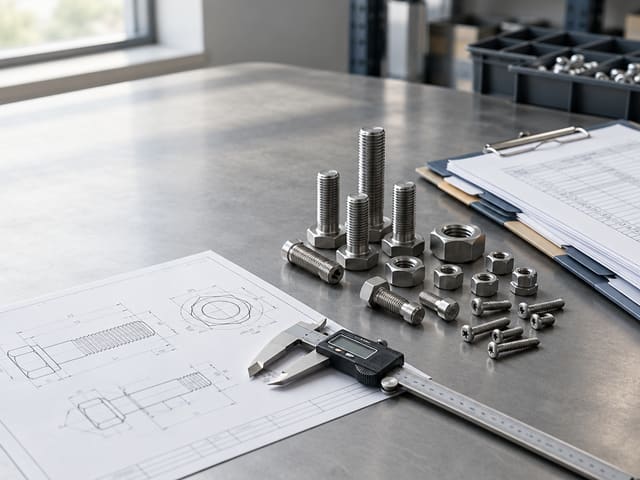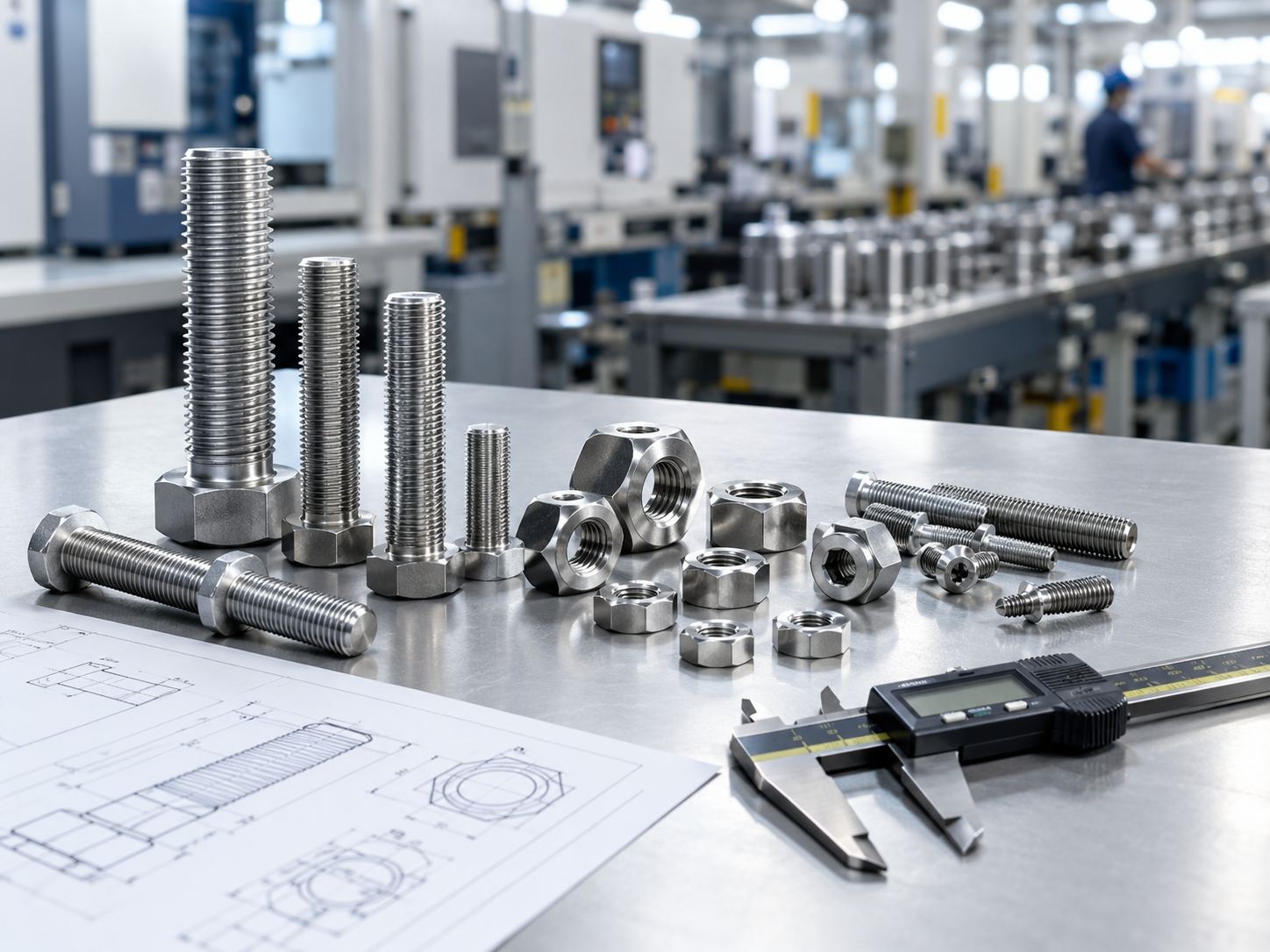
Full Fastener OEM Contract Manufacturing Process: From Inquiry and Sample Validation to Mass Production and Supplier Evaluation

Daniel
With experience in fastener manufacturing and export sales, we specialize in bolts, nuts, screws, self-drilling screws, fully threaded rods, and customized fastening solutions for construction, machinery, automotive, and industrial applications.
From Inquiry to Mass Production: A Full-Process Breakdown of Fastener OEM Contract Manufacturing and a Methodology for Supplier Capability Assessment
Fastener OEM contract manufacturing may appear to be merely "machining to drawing," but in reality it is a complete chain running from requirement clarification, technical review, and sample validation to volume delivery. Many projects perform well at the sample stage, yet once they enter mass production, problems such as dimensional variation, insufficient batch consistency, delivery delays, and even joint failure emerge. This article breaks down the full process in the order in which a project advances and provides a practical supplier capability assessment method to help procurement and engineering teams keep risk under control before scaling up.
I. Why Fastener OEM Projects Are Prone to Problems Before and After Mass Production
From the perspective of procurement pain points, problems are often already seeded at the inquiry stage. Drawings that do not match actual operating conditions, incomplete confirmation of screw or nut specifications, and vague descriptions of materials and surface treatment all lead suppliers to quote and schedule production based on their own interpretation. Only after samples pass and volume orders are placed does it become apparent that batch consistency is insufficient, or that delivery, cost, and quality are difficult to balance simultaneously.

Structural connections cannot be judged by a single fastener alone. Taking high-strength structural bolts as an example, the material grade, heat treatment process, head dimensions, preloading method, and anti-loosening solution all affect overall connection performance. TakeHeavy Hex Structural Bolt ASTM A325as an example. This type of high-strength carbon steel fastener is widely used in steel structures, bridges, and industrial plants, and its performance depends on the coordinated control of material, heat treatment, and thread precision; fluctuation in any one of these links may affect node safety. Likewise, for mechanical assembly and general industrial use,IS 1363 Hex Bolts, available in both carbon steel and stainless steel, appear conventional, but the consistency of their head dimensions, thread fit, and surface treatment directly determines assembly efficiency and long-term reliability.
Therefore, the core of supplier assessment is not only confirming "whether they can produce," but also verifying their engineering understanding, process control level, inspection and traceability system, and delivery assurance capability. The infrastructure and equipment manufacturing sectors continue to generate demand for fasteners, and project procurement should focus more on standard compliance, stable supply, and total lifecycle cost rather than simply comparing unit prices.

II. Inquiry Stage: Turning Requirements into Quotable, Manufacturable Specifications
High-quality inquiry materials are the foundation for all subsequent work. It is recommended to prepare the following: product drawings or physical samples, applicable standards and grades, key dimensions and tolerances, material requirements, surface treatment methods, application conditions, estimated quantities, packaging requirements, and destination market. The more complete the information, the smaller the quotation deviation.
It is necessary to distinguish product categories and usage scenarios. Bolts, studs, nuts, and different types of screws differ significantly in load-bearing behavior and assembly requirements, and when necessary, load, vibration, temperature, and corrosive environment descriptions should be supplemented. For example, steel structure projects should specify preloading requirements and anti-loosening solutions, while mechanical assembly projects should state the assembly tools and tightening torque range.
Standards and versions must be clearly stated. Export projects should verify the applicable ASTM, ISO, DIN, or customer standards; for structural grades such as A325, the current standard reference and the specific requirements of the project specification must be confirmed to avoid acceptance disputes caused by version differences. At the same time, suppliers should be required to list in their quotations thequotation assumptions and unconfirmed items, so that misunderstandings regarding materials, grades, surface treatment, or inspection scope are exposed in advance.
When initially screening fastener manufacturers and fastener suppliers, focus on experience with similar products, equipment and process range, certification documents, export experience, and engineering response speed. A supplier that proactively raises process questions is usually more worthy of advancing to the next round than one that only quotes low prices.
III. Technical Review and Quotation: Compare Total Cost, Not Just Unit Price
Technical review should first verify manufacturability: whether thread specifications, shank diameter, length, head type, grade, fit relationships, and special dimensions are suitable for existing processes and tooling. Next is evaluating the material and process route; choices such as carbon steel or stainless steel, cold heading or machining, heat treatment, electroplating or hot-dip galvanizing should all match performance requirements and the service environment.
Special products require separate evaluation. For custom special-shaped fasteners, non-standard fastener machining, custom socket head cap screws, and high-strength bolt projects, tooling investment, trial production cycle, and inspection plans should be confirmed to avoid later disputes over tooling ownership or trial production costs. For custom bolt wholesale projects, batch tiers and price tiers must also be clearly defined.
Quotations should be broken down into items such as materials, machining, heat treatment, surface treatment, testing, packaging, tooling, and transportation, and MOQ, lead time, payment terms, and quotation validity should be confirmed. When comparing total cost, include nonconforming rework, batch variation, packaging damage, delays, and cross-border compliance costs. A low price often means some inspection has been omitted, and that cost will ultimately return to the buyer in another form during mass production.
IV. Samples and Validation: Establishing a Quality Baseline Before Mass Production
At the sample stage, the scope must first be confirmed: appearance, key dimensions, threads, material, mechanical properties, surface treatment, and packaging markings. Suppliers should be required to use materials and processes that are consistent with or traceable to mass production, and first article inspection or small-batch trial production should be conducted when necessary.
Validation items should be established according to product risk. Routine items include dimensional and go/no-go gauge checks, hardness, tensile or torque testing, and coating thickness and corrosion resistance verification. For products such as hex bolts, flange bolts, and lock nuts, emphasis should be placed on verifying head or flange dimensions, fit precision, locking performance, and compliance with applicable standards.
Sample approval must be documented in writing: marked drawing version, material batch, inspection results, deviation handling method, and approver. This record will become the basis for mass production acceptance and the baseline document for subsequent change management.
V. Trial Production and Mass Production: Focus on Process Control and Batch Consistency
Before mass production, the control plan should be confirmed, including key quality characteristics, inspection frequency, equipment and tooling status, process parameters, and abnormal escalation mechanisms. Process interfaces are equally important; forming, cutting, thread rolling, heat treatment, surface treatment, and packaging should each have clearly defined responsible persons and records.
Inspection and traceability capability is the core of the mass production stage. Material certificates, batch numbers, in-process inspection, final inspection, and isolation of nonconforming products should be traceable to specific orders. For stainless steel fasteners, hot-dip galvanized bolts, and high-strength products, it must also be confirmed that material grades, performance requirements, and surface treatment do not conflict with one another, for example, control of hydrogen embrittlement risk in high-strength parts during hot-dip galvanizing.
After trial production, yield, cycle time, dimensional stability, and delivery performance should be reviewed, and only after passing should volume production proceed according to the approved process and acceptance standards. Trial production is not a formality but the last window for discovering systemic problems.
VI. Supplier Capability Assessment: Building a Scorecard from Seven Dimensions
It is recommended to establish a structured scoring table from the following seven dimensions and set weights according to project importance:
- Engineering capability:Whether they can read drawings, identify risks, provide process recommendations, and handle non-standard requirements.
- Manufacturing capability:Verify equipment, molds, production capacity, outsourcing management, and actual experience with target categories such as screws, nuts, and bolts.
- Quality capability:Review the quality system, inspection equipment, calibration records, material traceability, abnormality correction, and customer complaint handling mechanisms.
- Delivery capability:Evaluate capacity load, production scheduling transparency, material preparation strategy, on-time delivery records, and emergency order response capability.
- Compliance and export capability:Confirm target market requirements, product documentation, packaging labels, document coordination, and export experience; for export projects of inch-series bolts, the consistency between standard versions and customer specifications should also be verified.
- Commercial and risk management:Compare quotation transparency, payment and confidentiality arrangements, mold ownership, intellectual property protection, and supply interruption contingency plans.
- Comprehensive verification:Score based on document review, on-site or remote audits, sample verification, and trial order results, and avoid making decisions based solely on promotional materials or quotations.
The value of the scoring table lies in converting subjective impressions into comparable data and continuously updating it during the cooperation process.
7. From small-batch trial orders to long-term cooperation: match suppliers by category
It is recommended to first use trial orders to verify communication efficiency, quality stability, packaging level, and delivery performance, then gradually expand order volume and regularly review key indicators. Different categories should be matched with suppliers with different expertise: hex bolt manufacturers, flange bolt suppliers, carriage bolt factories, heavy hex nut manufacturers, and carbon steel nut factories should have their corresponding equipment and process experience verified separately, rather than using one general-purpose factory to cover all needs.
For lock nut suppliers, self-tapping screw manufacturers, self-drilling screw suppliers, machine screw wholesale, and expansion bolt wholesale projects, product standards, installation conditions, and acceptance methods should be clearly defined, because these categories are often closely related to specific construction scenarios. For stainless steel fastener manufacturers, high-strength bolt manufacturers, hot-dip galvanized bolt suppliers, and custom special-shaped fastener projects, priority should be given to examining whether material control, process routes, and the inspection closed loop are complete.
The final choice should be a fastener OEM partner that can simultaneously cover quality, cost, delivery, and technical support. Through drawing version management, supplier performance reviews, and change approval mechanisms, turn a successful project into a long-term stable supply relationship. For buyers with export needs, priority should also be given to partners with experience as fastener export suppliers and familiarity with destination market standards and document processes, thereby reducing hidden risks in cross-border delivery.