Automotive Fastener B2B Procurement: Using ISO/DIN Compliance Systems to Shorten Delivery Cycles

Daniel
With experience in fastener manufacturing and export sales, we specialize in bolts, nuts, screws, self-drilling screws, fully threaded rods, and customized fastening solutions for construction, machinery, automotive, and industrial applications.
Starting from an urgent insert order: How can automotive fastener B2B procurement use an ISO/DIN compliance system to shorten delivery cycles by 30%?
At four in the afternoon, a production planner at an automotive parts factory received notice of a temporarily added order from the OEM. The entire assembly line had already been scheduled for production, and the rate of material consumption at the workstations far exceeded expectations. The procurement team then discovered that a batch of high-strengthboltsand matchingnutsfrom the original supplier could not arrive on time, while those in the warehouse that "looked about the same"screwscould not be signed off for release by anyone because the standard numbers were unclear, material certificates were missing, and surface treatment requirements were inconsistent. This is not an isolated scenario, but a typical dilemma that repeatedly occurs in automotive fastener B2B procurement.
1. An urgent insert order exposes the "hidden waiting" in automotive fastener procurement
The pressure brought by an urgent insert order is never singular. Procurement staff often have to handle simultaneously within a few hours: unclear drawing versions, wide specification spans, opaque inventory status, missing material certificates, inconsistent inspection standards, and temporary changes to packaging and traceability requirements. The production line is waiting for materials, the quality department is waiting for documents, the engineering department is waiting for confirmation, and the supplier is waiting for a reply - every link is waiting, but no link is truly "producing."

The fastener category has a particular characteristic: there are extremely many categories and an extremely wide specification span, and simply "having stock" does not equal "ready for production use." A single non-compliantboltornutmay cause an entire batch of materials to be stranded in the pending inspection area, or even cause the entire production line to shut down. What truly lengthens lead times is often not manufacturing itself, but the "hidden waiting" links such as selection confirmation, standard verification, completion of quality documents, incoming inspection, and abnormal rework.
The core viewpoint follows from this: establishing an ISO/DIN compliance system can turn procurement communication from repeated confirmation into standardized invocation, creating the conditions for shortening the delivery cycle by 30%. This is not a slogan, but a mechanism that can be broken down, executed, and quantified.
2. Why is urgent procurement of automotive fasteners most afraid of "correct specifications, wrong standards"?
In automotive manufacturing and parts assembly scenarios, dimensional matching of fasteners is only the most basic threshold. What truly determines whether they can go into production is the simultaneous confirmation of performance grade, material grade, heat treatment condition, surface treatment method, torque requirements, and anti-loosening performance. Correct specifications with the wrong standard often result in something more troublesome than "out of stock" - because the materials have already arrived at the factory but cannot be used.
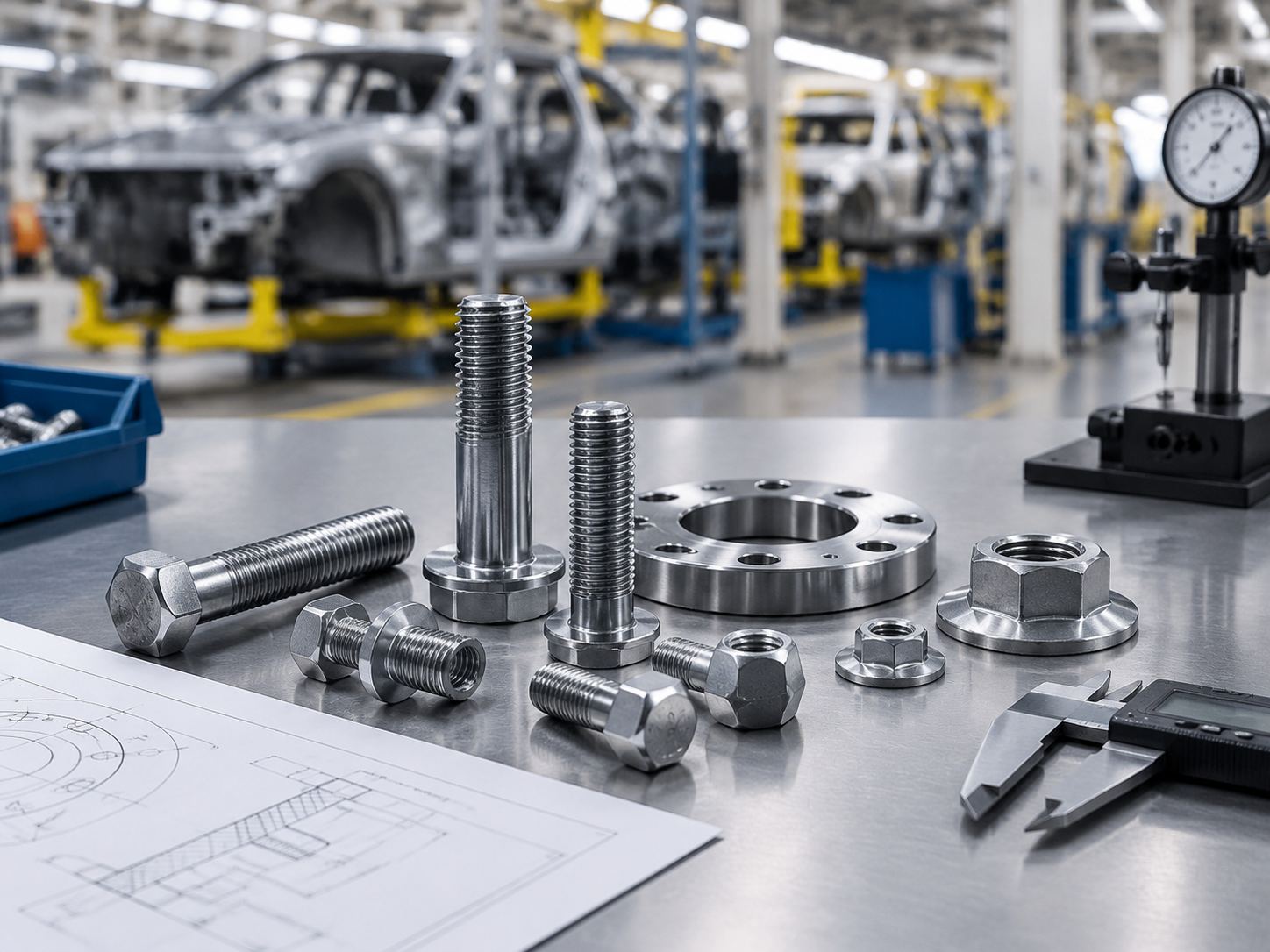
Common procurement items include hex bolts, flange bolts, studs, lock nuts, socket head cap screws, and various custom special-shaped fasteners, each corresponding to different connection locations and failure risks. For example, for critical structural connections,flange boltshave extremely high requirements for friction coefficient and preload consistency; whilestudsused in support systems place more emphasis on thread fit and anti-loosening design.
ISO and DIN standards and customer drawings are complementary: ISO/DIN provide general dimensions and technical specifications, while customer drawings may supplement special material, coating, salt spray, friction coefficient, marking, and packaging requirements. Common misunderstandings include: directly substituting screws and bolts that look similar; ordering only by nominal diameter and length; and ignoring differences in thread tolerance, strength grade, or surface treatment.
It should be particularly emphasized that threads are the main load-bearing area of fasteners. Thread impact damage, corrosion, burrs, and abnormal plating all affect assembly efficiency, preload stability, and subsequent service reliability. This is also why a compliance system must include thread quality as a core inspection item and cannot look only at appearance.
3. Using an ISO/DIN compliance system to compress lead times: from "manual Q&A" to "standardized release"
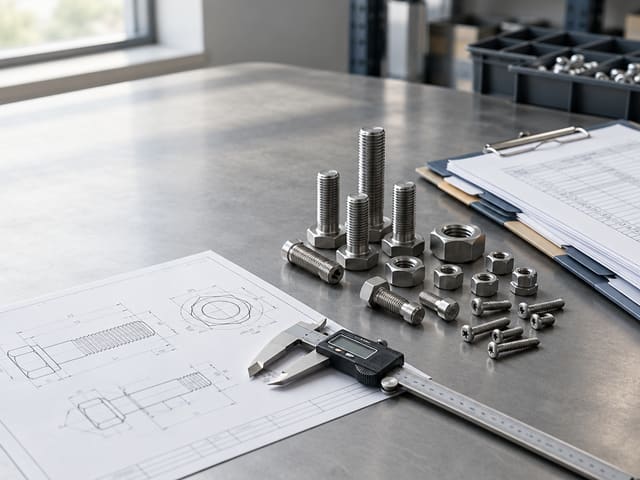
The first step of a compliance system is to establish standardized material master data. Each fastener SKU uniformly records the standard number, specification, pitch, performance grade, material, surface treatment, hardness, applicable location, and substitution boundaries. In this way, procurement, engineering, and quality all invoke the same language, rather than each understanding "about the same."
The second step is to establish a mapping relationship among drawings, standards, and processes. For example, map products such as hex bolts, flange bolts, and nuts to applicable ISO/DIN standards and internal enterprise technical requirements, so that every inquiry sheet can directly cite standard clauses instead of relying on repeated descriptions in emails.
The third step is to move compliance requirements forward to the inquiry and quotation stage. The procurement RFQ clarifies in one go the standards, quantity, delivery time, inspection items, certificate requirements, packaging method, and label traceability rules. Takinghex boltsFor example, if the performance grade, thread tolerance, and coating requirements are already specified in the RFQ, the supplier's quotation and technical confirmation can be completed in one go.
The fourth step is to implement a "fast release for standard parts, special review for special parts" mechanism. Compliant parts within the catalog can be quickly locked in; projects involving non-standard fastener machining, custom special-shaped fasteners, or fastener OEM contract manufacturing enter the technical review process. This triage mechanism prevents all materials from going through the same approval channel, thereby saving time for the projects that truly require review.
The fifth step is to shorten post-arrival waiting through preset inspection rules. Key dimensions, thread go/no-go gauges, mechanical properties, and coating or anti-corrosion requirements are defined in advance, reducing ad hoc disputes during incoming inspection. When inspection rules are agreed upon in advance, release after arrival no longer depends on "whoever has time today to explain the standard."
IV. Breaking Down the 30% Lead Time Reduction: Where Exactly Is the Time Saved?
Requirements confirmation stage: Use standard codes and specification templates to reduce multiple rounds of clarification among procurement, engineering, quality, and suppliers. A clear specification template can often save two to three rounds of email back-and-forth.
Supplier matching stage: Screen fastener manufacturers by product capability, such as high-strength bolt manufacturers, stainless steel fastener manufacturers, carbon steel nut factories, or flange bolt suppliers, rather than ranking solely by price. Matching with the wrong supplier will incur costs at every subsequent stage.
Production scheduling stage: Establish safety stock, semi-finished goods inventory, or fast scheduling channels for highly standardized screws, nuts, and bolts. An inventory strategy is not about "stocking more" but about "stocking the right items."
Quality documentation stage: Set material certificates, heat treatment records, coating reports, dimensional inspection records, and batch traceability documents as items delivered with the goods, avoiding the need to supplement documents after arrival. Documents traveling with the goods is one of the most direct means of compressing waiting time.
Inspection and warehousing stage: Release quickly based on predefined sampling plans and acceptance criteria, reducing pending-inspection time caused by inconsistent interpretation of standards.
It should be noted that "30% reduction" should be treated as a quantifiable improvement target, not a promised figure. Enterprises should use their own historical procurement cycles as a baseline and separately measure the duration of inquiry, sampling, production, transportation, inspection, and exception handling to know exactly where the time is saved.
V. Practical Process for Urgent Insertion Orders: What Information the Buyer Should Submit
Basic specifications: Product name, standard number, diameter, length, pitch, head type or flange dimensions, thread length, and quantity. The more complete this information is, the faster the supplier can respond.
Performance requirements: Strength grade, material grade, heat treatment condition, hardness requirements, torque or preload requirements, and whether a locking structure is needed. Forlock nutstype products, confirmation of locking performance is particularly critical.
Surface and environmental requirements: Black oxide, zinc plating, Dacromet, zinc-aluminum coating, hot-dip galvanizing, or stainless steel fastener solutions; specify corrosion resistance, salt spray, and appearance requirements. Hot-dip galvanized bolt suppliers need to confirm coating thickness and adhesion standards in advance for such requirements.
Quality and traceability requirements: Whether material certificates, third-party testing, PPAP documentation, RoHS/REACH declarations, batch labels, and packing lists are required.
Delivery requirements: Target arrival date, batch quantities, receiving location, packaging specifications, and whether packaging by workstation or kit is required.
For custom socket head cap screw projects, custom bolt wholesale, and non-standard fastener machining projects, it is recommended to provide 2D drawings, 3D models, samples, and critical dimensional tolerances at the same time. The more information is provided upfront, the smoother the review.
VI. How to Evaluate Fastener Suppliers: Look Beyond Price to "Emergency Delivery Capability"
Evaluate the supplier's standard coverage capability: Whether it can stably supply ISO/DIN standard parts and whether it is familiar with the automotive industry's quality control requirements for bolts, nuts, and studs.
Evaluate manufacturing and collaboration capability: Whether the fastener manufacturer has coordinated capabilities in cold heading, thread rolling, heat treatment, surface treatment, sorting, packaging, and third-party testing. A complete process chain means that anomalies can be quickly identified and remedied.
Evaluate inventory and capacity transparency: Whether the supplier can provide real-time information on stock, work-in-progress, raw materials, and available capacity for insertion orders. Information transparency is the prerequisite for whether urgent insertion orders can be executed.
Evaluate quality traceability capability: Whether traceability can be performed by heat lot, heat treatment batch, surface treatment batch, and packaging batch, and whether complete quality documents can be provided quickly.
Evaluate the exception response mechanism: Whether there are isolation, re-inspection, replenishment, and corrective and preventive processes in place when thread damage, corrosion, material mixing, dimensional out-of-tolerance, or packaging label errors occur.
For cross-border business such as American standard bolt exports and fastener export suppliers, standard conversion, document language, packaging specifications, and destination compliance requirements should also be verified. The compliance risks of cross-border procurement are often more hidden than those of domestic procurement.
VII. Case Review Framework: How to Avoid Line Stoppage During Emergency Replenishment of a Batch of Flange Bolts
Set the case background: An automotive parts company, due to a demand forecast deviation, needs to urgently replenish a batch of flange bolts and matching nuts with specified performance grades and surface treatment.
Initial problem state: The original procurement information contained only specifications and quantities, lacking clear standards, coating requirements, a quality document list, and packaging label rules.
Solution action one: The procurement, engineering, and quality departments locked down key parameters based on ISO/DIN standards and customer drawings, and formed a unified technical confirmation sheet.
Solution action 2: The supplier evaluates the supply path in the order of "finished goods inventory—semi-finished goods that can be reworked—rapid scheduling," while confirming the batch quality documents.
Solution action 3: Adopt the pre-agreed critical-item inspection and rapid acceptance plan, and upon arrival directly complete sampling inspection, warehousing, and workstation delivery.
Review metrics: Compare the demand confirmation time, supplier response time, production preparation time, document completeness rate, incoming material release time, and line stoppage risk before and after optimization.
Case conclusion: Delivery improvement does not rely on expediting by a single supplier, but on the coordination of procurement standards, supplier capabilities, and quality release rules.
8. Avoiding "expediting turning into rework": Six risk controls in automotive fastener procurement
Prohibit substitutions without engineering confirmation: Bolts with different standards, strength grades, coatings, or thread tolerances must not be replaced merely because they look similar.
Focus on preventing mixed materials: Screws and nuts with the same appearance but different performance grades should use separate packaging, clear labels, and batch isolation.
Strictly control thread quality: Check for crossed threads, missing threads, crushing, burrs, rust, and go/no-go gauge results to prevent assembly jamming or preload failure.
Verify surface treatment compatibility: Avoid rework caused by coating thickness, hydrogen embrittlement risk, friction coefficient, or corrosion resistance not meeting requirements.
Clarify packaging protection requirements: Prevent impact, moisture, and rust during transportation; especially high-strength bolts and precision nuts should avoid thread damage.
Maintain a complete traceability chain: From raw materials, manufacturing, heat treatment, surface treatment, to shipping batches, all should be traceable to provide a basis for quickly locating quality anomalies.
9. Implementation checklist for B2B procurement managers: Establish a replicable rapid delivery mechanism
Establish an A/B/C category fastener list: Category A covers parts with high line stoppage risk and delivery sensitivity; Category B covers commonly used standard parts; Category C covers low-frequency or customized parts, with different inventory and approval strategies matched to each.
Establish a compliant selection library for high-frequency screws, nuts, hex bolts, and flange bolts, unifying standard numbers, performance grades, surface treatments, and preferred supplier information.
Sign emergency delivery SLAs with core fastener suppliers, specifying response time, inventory commitments, timeliness of quality documents, replenishment mechanisms, and responsibility for handling anomalies.
Review the procurement cycle monthly: Identify recurring waiting nodes, such as technical confirmation, document completion, inspection disputes, transportation delays, and packaging errors.
Include both delivery performance and quality performance in supplier assessment to avoid pursuing only short-term low prices or one-time expediting capability.
Closing call to action: Before the next urgent insert order, first complete the ISO/DIN standard review of core fasteners, material coding governance, and supplier capability inventory. True rapid delivery capability is not obtained through last-minute expediting, but is built up over time through a compliance system.